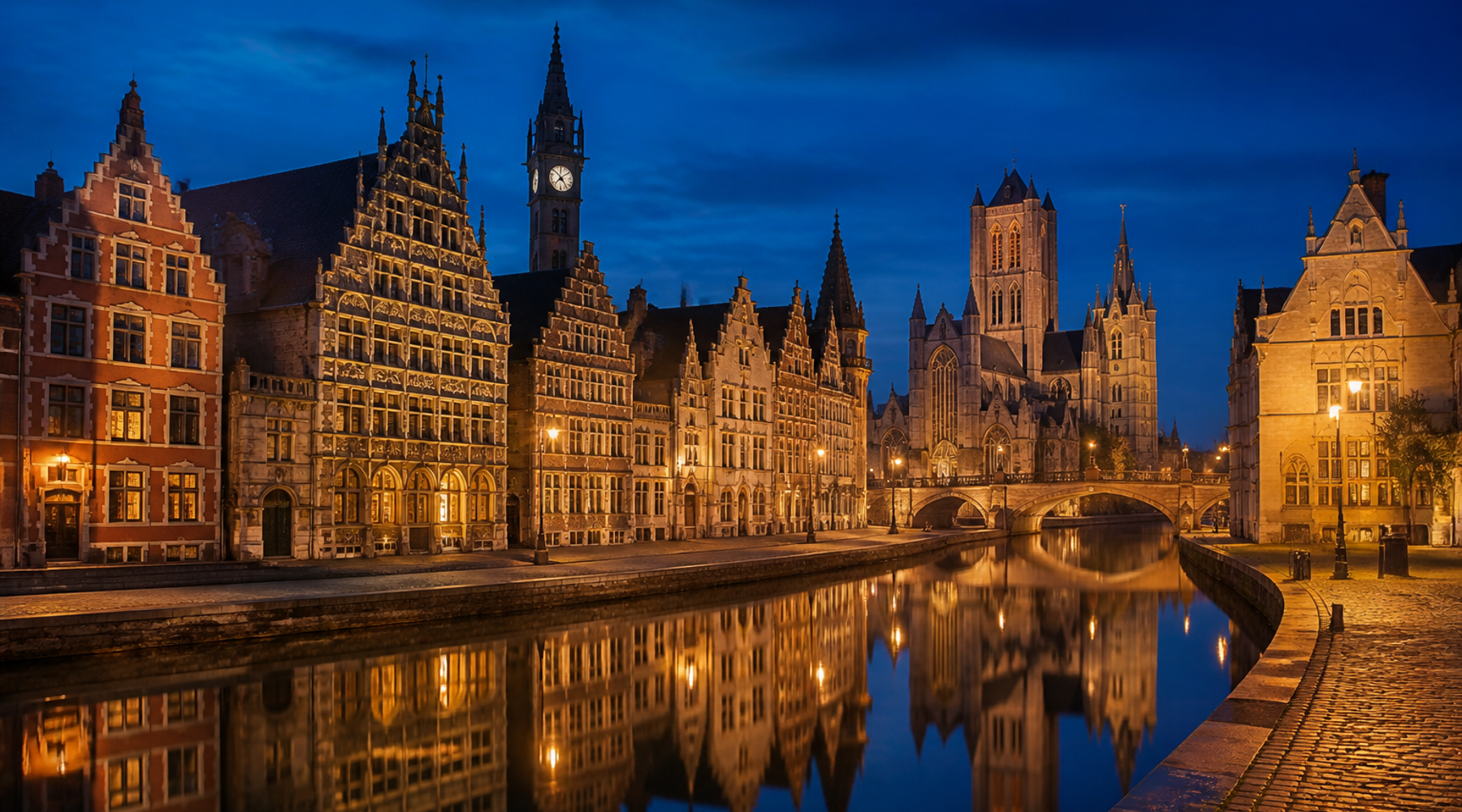
While neighboring cities embrace the rush of the 21st century, Ghent remains a preserved marvel of medieval architecture and canal-side culture. Here is why this Belgian gem feels truly untouched by time.
A Living Medieval Tapestry
Stepping into Ghent, Belgium, often feels less like a vacation and more like a temporal shift. Unlike many European hubs that have modernized their skylines, Ghent’s core is dominated by the 'Three Towers'—St. Nicholas' Church, the Belfry, and St. Bavo’s Cathedral. These structures have loomed over the city since the Middle Ages, offering a skyline that has remained largely unchanged for centuries.
The Graslei and Korenlei Quays
The heart of the city’s timeless appeal lies along the Lys River. The two quays, Graslei and Korenlei, are lined with guildhalls dating back to the 12th century. Walking these banks at dusk, when the original stonework is illuminated and reflected in the water, removes any sense of the modern world. The absence of heavy motorized traffic in the historic center further enhances the illusion of a simpler era.
Gravensteen: The Castle of the Counts
Dominating the northern edge of the old town is Gravensteen, a 10th-century fortress complete with a moat and battlements. It remains one of the best-preserved castles in Europe. Its massive stone walls were designed to intimidate, and today they serve as a physical barrier between the modern outskirts and the historical core, preserving the atmosphere of a medieval stronghold.
A Culture of Preservation
What truly keeps Ghent frozen in time is not just the stone and mortar, but the pace of life. The city has one of Europe’s largest car-free zones, allowing the sound of footsteps and bicycle bells to replace the hum of engines. Local markets still operate under traditional rules, and the craftsmanship found in the city’s many small workshops reflects a dedication to heritage over mass production.
Sustainable History
While Ghent is a functional, thriving city, its commitment to preservation ensures that its history is lived in rather than treated as a museum. Residents live in converted historical warehouses, and students from the local university fill the ancient squares. It is this balance of active daily life and rigid architectural preservation that makes Ghent one of the few places in Europe where the past feels entirely present.
Written by
Viralized Staff