
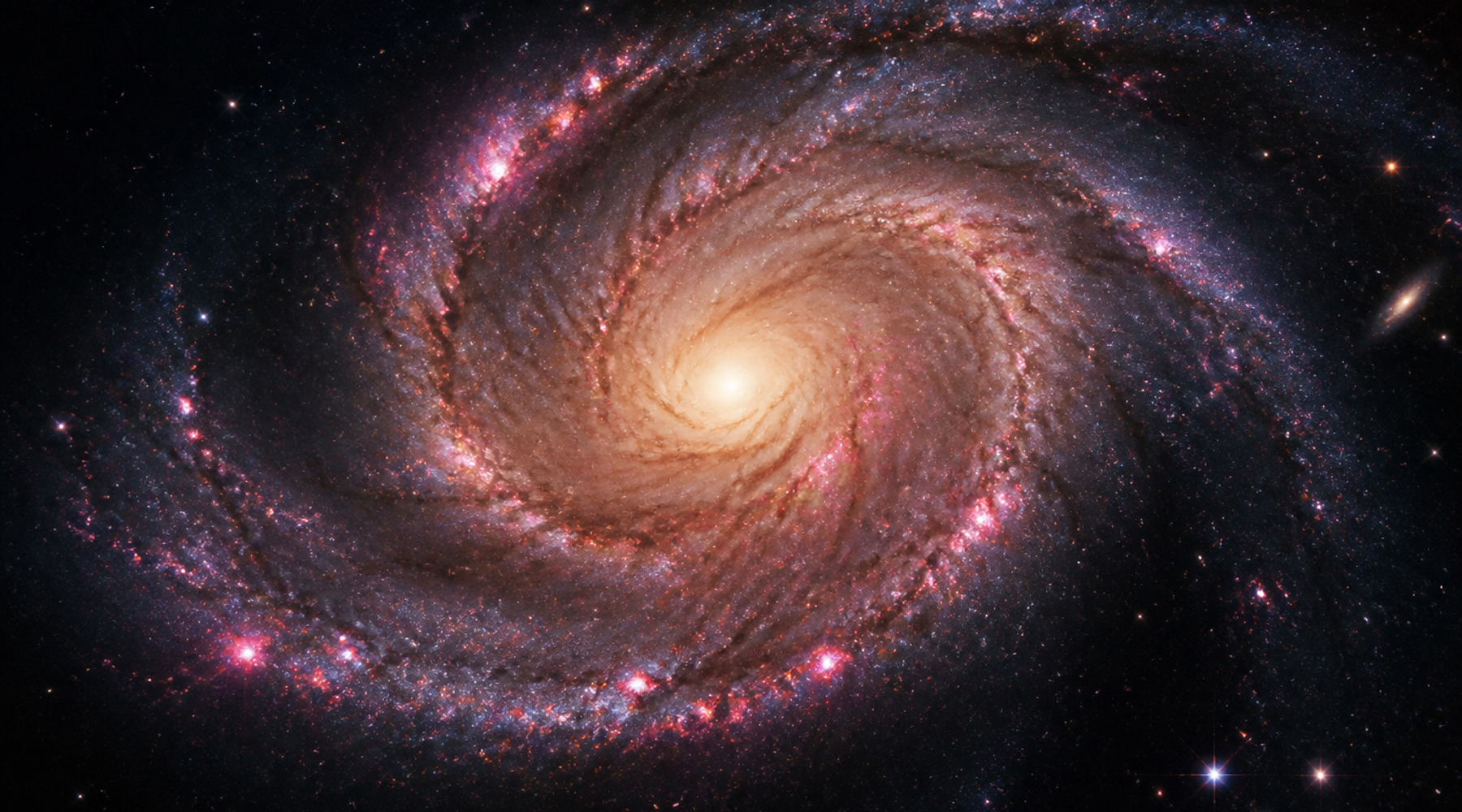
The James Webb Space Telescope has captured an unprecedented look at galaxy NGC 1559, revealing new details about star formation and cosmic dust with its MIRI and NIRCam instruments.
## A New Standard for Cosmic Clarity
NASA has released what astronomers are calling the sharpest image ever captured of the spiral galaxy NGC 1559. Located approximately 35 million light-years away in the constellation Reticulum, this barred spiral galaxy is now being seen in a new light thanks to the combined power of the James Webb Space Telescope’s Near-Infrared Camera (NIRCam) and Mid-Infrared Instrument (MIRI).
## Piercing Through the Dust
Unlike previous images captured by the Hubble Space Telescope, which primarily saw visible light, Webb's infrared capabilities allow it to look through the thick clouds of cosmic dust that often obscure galactic centers. The result is a high-definition map of the galaxy’s structural skeleton, highlighting the distribution of stars and the intricate lanes of gas where new suns are currently forming.
## The Role of NGC 1559 in Science
NGC 1559 is an essential subject for researchers because it is a prolific producer of supernovae. Scientists track these explosive events to better understand the distances between galaxies and the expansion rate of the universe. The new level of detail provided by Webb allows astronomers to pinpoint exactly where these stellar explosions occur relative to the galaxy’s spiral arms.
## Implications for Future Discovery
This image is part of the PHANGS program, a global effort to map nearby galaxies in unprecedented detail. By studying galaxies like NGC 1559, NASA aims to build a more comprehensive history of how galaxies evolve over billions of years. The clarity of this data ensures that researchers will be dissecting these pixels for years to come, looking for clues about the life cycles of stars and the matter that connects them.
Written by
Viralized Staff